Making room for a sparrow colony
Think about several neighbouring nest spaces and the habitat around them, rather than treating a terrace box as a guarantee.
Start with the local sparrows
House sparrows are social birds, so a group of nest spaces can make sense where they already occur. Listen for the chatter around nearby hedges and rooflines. A new box in an area with no visible sparrow activity may take time to attract interest, and additional entrances cannot compensate for a lack of suitable surrounding habitat.
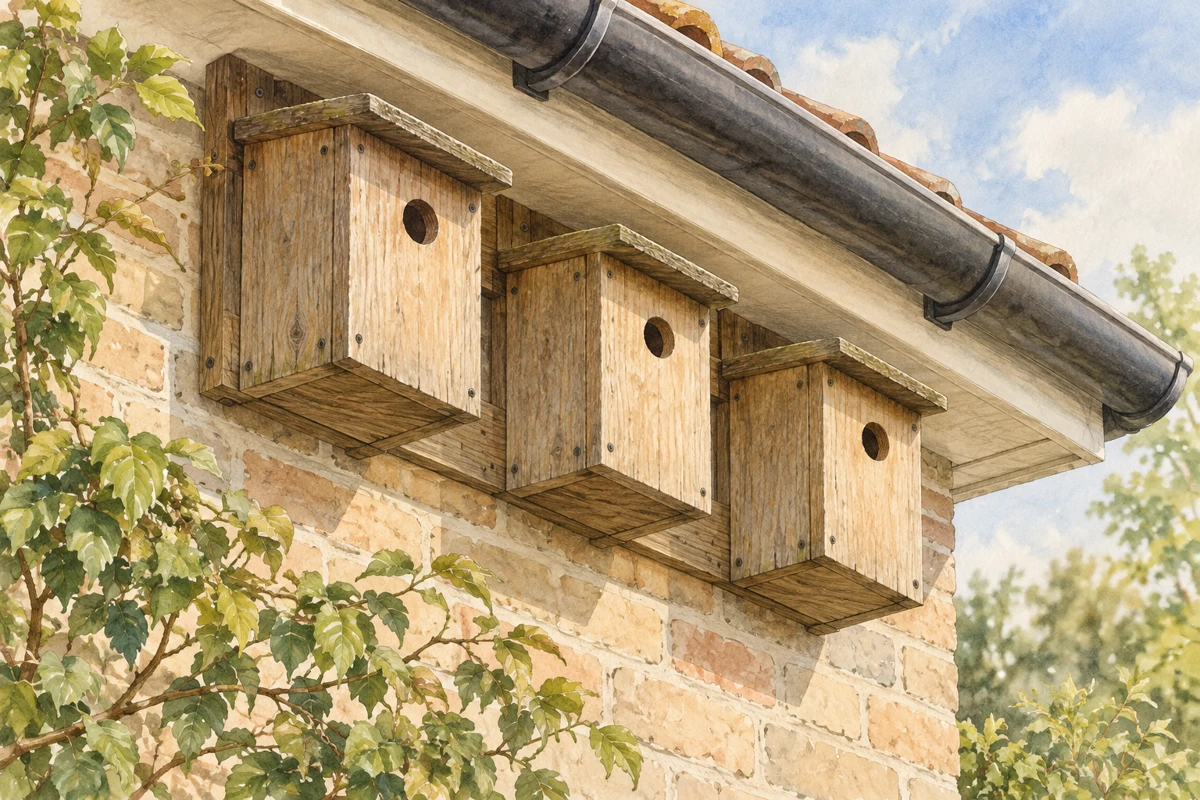
The choice is not simply between one box and a multi-compartment terrace. Separate boxes can provide several spaces while allowing more flexibility over position and future repairs. Compare the internal design of each compartment, not just the number of holes shown on the packaging.
Give each chamber its own space
A terrace should have properly separated nesting chambers rather than several entrances into a shared open cavity. Check the plan, the chamber measurements and the maintenance access. Each part needs a suitable entrance and a sound floor; a narrow end compartment is not improved by the overall width of the product.
For house sparrows, a 32 mm round entrance is a common specification in BTO guidance. Use that with an appropriate sparrow-box plan, not as a reason to drill a row of holes into any spare wooden container. If buying separate boxes, keep the model details so a damaged unit can later be replaced consistently.
A colony is more than housing
Look beyond the wall. Dense cover, places to forage and insects for growing young are part of the setting. A garden stripped of vegetation with several boxes attached to it is offering only one part of what the birds need.
Avoid concentrating feeders immediately below the nest entrances. Regular feeding traffic and the activity involved in cleaning a station are better kept elsewhere. Plan the wall's other uses as well: a proposed awning or security light should not unexpectedly obstruct the route after the boxes are occupied.
Expect an uneven result
One compartment may be used while another remains empty. That is not an instruction to rearrange the occupied structure or open neighbouring chambers repeatedly. Watch from a distance and record which entrances receive visits.
House sparrows can have more than one brood, so a quiet interval is not proof that all breeding has finished. Leave maintenance until an appropriate inactive period, checking the current nest-box guidance. Where several chambers share one front panel, treat the whole structure as occupied if any compartment is still in use.