Following a family of long-tailed tits
Give a passing flock time to cross the garden; the first bird is rarely the whole story.
The hedge starts moving
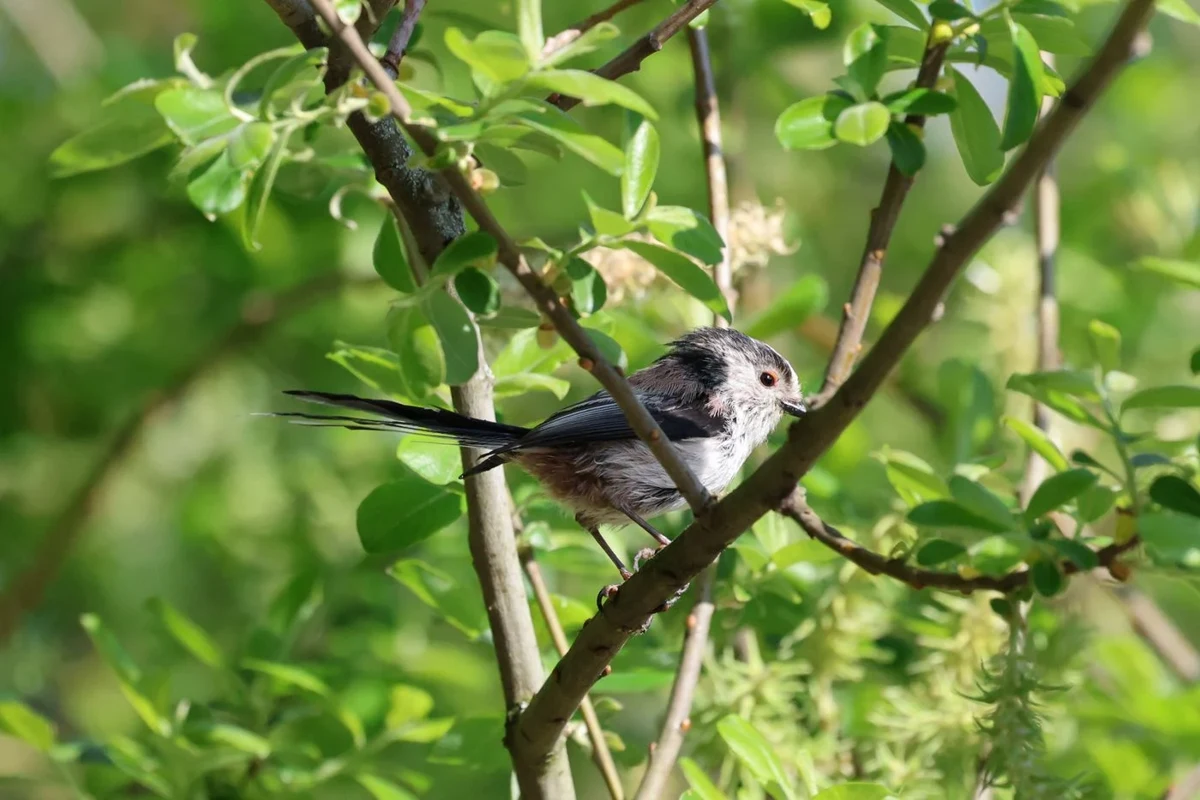
Long-tailed tits often announce themselves as several small sounds moving through a hedge. Then a tiny round body appears, followed by a tail that seems too long for it. Black, white and pinkish plumage, a very small bill and that elongated silhouette make a good combination of clues. In poor light, shape can be more useful than colour.
If one passes across an opening, keep watching the same gap. Others may follow at different heights. Turning immediately to chase the first bird with binoculars can mean missing most of the group. A gate opening or a space between two shrubs can become a useful observation point without anything being moved or cut.
Count a passage carefully
Suppose three birds cross from left to right, then two appear in the shrub on the right. Those two may be among the original three. Record the sequence instead of automatically adding every appearance. If the movement becomes confused, a minimum count is more honest than a precise-looking total you cannot defend.
It can help to leave binoculars down until the group has passed, then use them on one settled bird. Wide awareness first, detail second. For photography, the same approach avoids spending the entire encounter with a lens aimed at an empty twig.
Flocks are sociable, but a garden view cannot reveal every relationship within one. Calling a group a family is a convenient description, not proof that all its members are parents and offspring. Write group if you have no evidence beyond birds travelling together.
Let the flock keep its route
The visit may last only a minute. That does not mean the garden has failed to hold their interest. Small birds can use a chain of gardens, hedges and trees rather than treating one property as a complete home. Their route is worth noticing over several days, while accepting that it may change.
In nesting season, do not follow a bird carrying material into dense cover. Long-tailed tits build enclosed nests rather than using a standard tit box, and searching for one can expose or disturb it. Watching the passing flock in autumn or winter provides plenty to learn without finding a nest at all.
Leave notes about the route and the plants used. Those observations can later inform garden decisions: the apparently untidy connection between two shrubs may be the feature the birds repeatedly use.