Finding a wren without seeing much of it
A short upright tail, a burst of movement and an unexpectedly loud voice are often all you get.
A bird between the branches
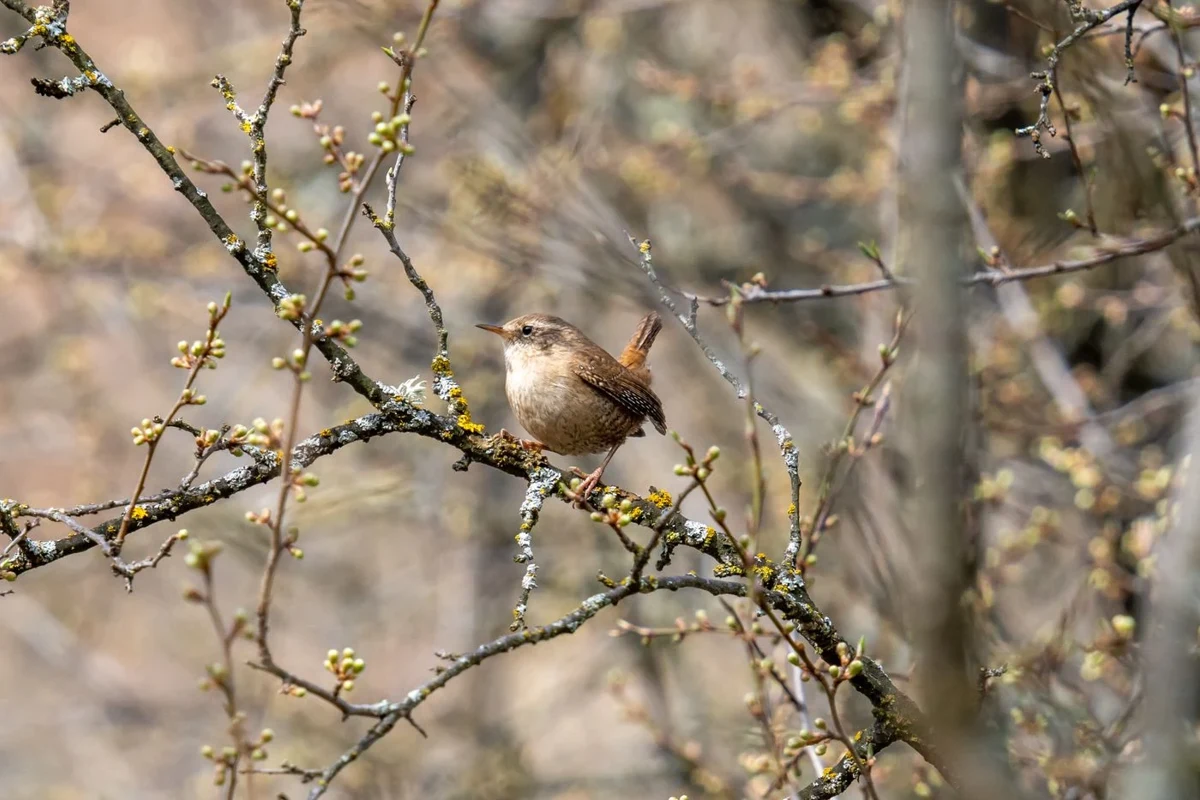
A wren can seem to occupy the gaps in a garden rather than its open spaces. One moment there is movement beneath a shrub; the next, a tiny brown bird pauses with its tail raised and vanishes again. Its rounded body and short, often cocked tail are useful clues, but posture changes. A bird is not disqualified from being a wren because its tail happens to be lowered.
The pale eyebrow and fine bill are helpful in a good side view. From a distance, however, it may be more productive to watch the route than to chase detail. Keep looking at the place where the bird disappeared. It may work through the same tangle and emerge farther along without ever crossing open ground.
The voice can fill the garden
The song is remarkably forceful for such a small bird, with a rapid, energetic quality and a pronounced trill. Try locating a singing bird from where you are rather than following the sound into dense vegetation. A short recording can help later, but leave playback for indoors and use it quietly.
One useful exercise is to describe the sound without naming it: fast, loud, a rattling section near the end. Then compare a reference recording. This approach preserves what you actually heard and makes it easier to distinguish a confident identification from a guess based on location.
A view does not require an opening
Dense growth is precisely what makes the wren interesting to watch. Cutting back a branch to improve the sightline changes the feature the bird is using. Choose a different existing viewpoint or accept a partial view instead.
If you are planning work around an old log pile, ivy or a thick shrub, remember that hidden spaces can be occupied. Check carefully for signs of nesting from a distance and postpone work where necessary. The absence of an obvious nest is not evidence that the vegetation is empty.
At the end of a short watch, a record such as wren moved through the ivy, then sang from the fence is enough. You have recorded both a route and a behaviour. A full-frame photograph would add detail, but it is not a requirement for a worthwhile sighting.