Choosing binoculars for a garden view
Begin with the distance to your nearest useful perch and the view you can hold comfortably.
Measure the garden before comparing specifications
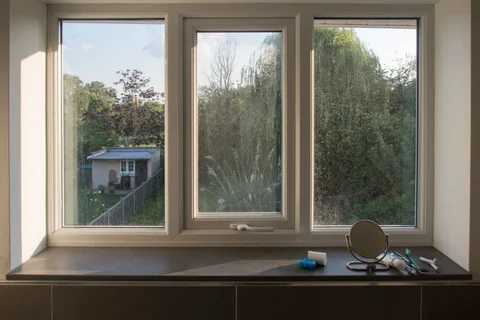
The nearest bird is not always the easiest one to see through binoculars. Some instruments cannot focus on a bird only a few metres from the window. Before shopping, estimate the distance to the nearest branch, the usual bathing place and the far boundary. These give you three real targets against which to judge a pair.
Also decide how the binoculars will be used. A pair kept beside a kitchen window has a different carrying requirement from one taken on a long walk. If two people will share it, each should try it. A view that feels effortless to one person may be awkward for another because their eye spacing, glasses or hand position differs.
What the two numbers tell you
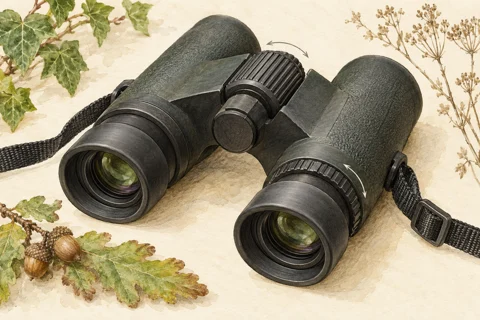
In a specification such as 8x32, the first number is magnification and the second is the objective lens diameter in millimetres. Higher magnification makes the subject appear larger, but it also makes hand movement more obvious and usually reduces the width of the view. A garden bird that jumps between branches is easier to follow when there is some space around it.
Eight-power binoculars are a reasonable starting point to try, not a rule that every buyer must follow. Compare them with another suitable option at a similar price. Look at the same target for long enough to judge steadiness, rather than deciding from the first bright impression.
Larger front lenses can help in dim conditions but add bulk. If the heavier pair stays in a cupboard because it is uncomfortable, its specification has not helped your birdwatching. Hold it for several minutes and operate the focus wheel repeatedly.
Check the fit to your eyes
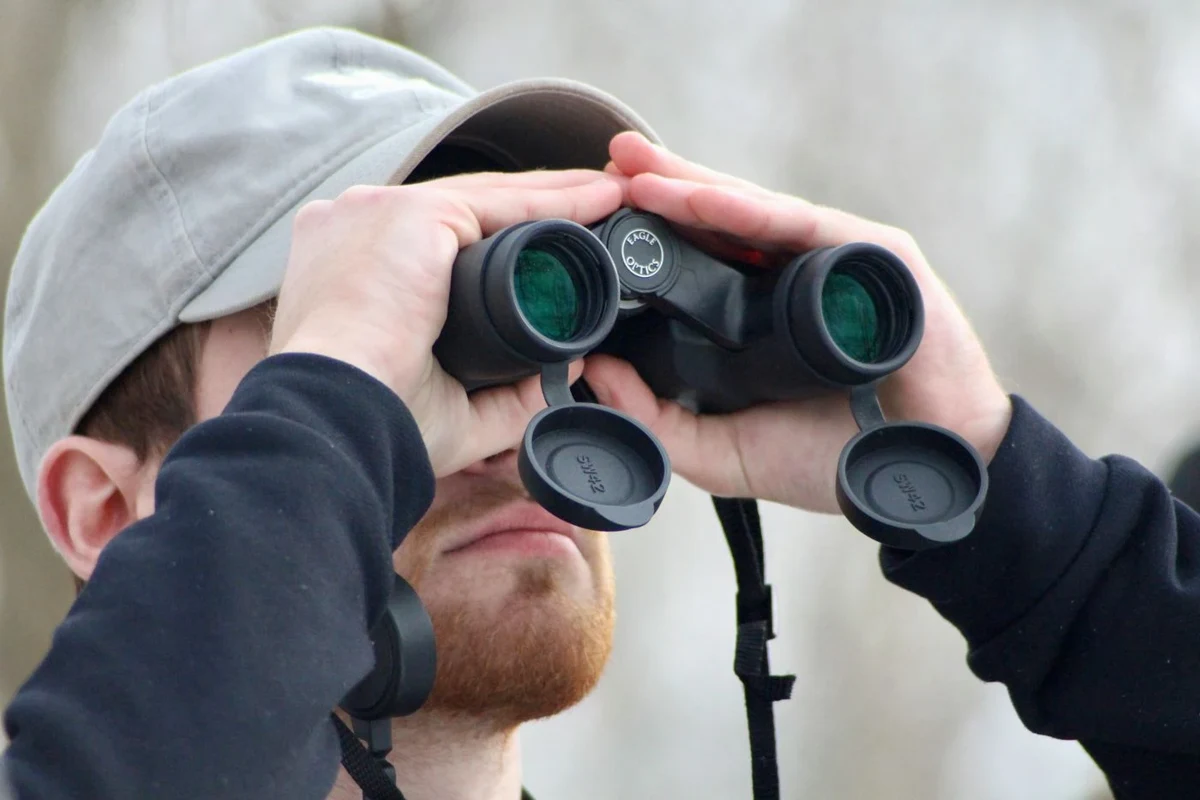
Adjust the hinge until the two views merge into one circular image. Set the eyecups for use with or without spectacles, following the instructions. Glasses wearers should check that they can see a comfortably wide field without pressing the lenses together. A restricted view can make finding a bird unnecessarily difficult.
Try the dioptre adjustment as well as the central focus. The dioptre compensates for a difference between your eyes; it is not a second zoom control. Ask for a demonstration if the mechanism is unfamiliar. If you cannot obtain a comfortable single image after correct adjustment, try another pair rather than assuming you need to tolerate strain.
Never point binoculars towards the sun, even briefly while searching a roofline. Choose test targets safely away from it.
Use three ordinary tests
First, focus on something at your nearest watching distance. A fence fastening or leaf edge is a patient substitute for a bird. Then shift to a distant branch and back. Can you move the focus smoothly without losing your grip?
Next, look into a shaded shrub. Check whether you can distinguish small details, not just whether the whole image looks bright. Finally, follow a moving subject at a safe distance, such as a leaf moving in the wind. Notice whether the field of view makes it easy to keep the subject in sight.
These tests should be done with the controls properly adjusted and, if possible, under comparable lighting. Comparing one pair through a sunny shop window and another in a dark corner does not tell you much about their relative performance.
Leave room for the unglamorous details
Check the warranty, weather resistance, strap attachment and the way the lens caps fit. For second-hand binoculars, inspect focus movement, alignment and visible damage, and use a seller who allows a proper examination or return. Do not buy a pair with an uncomfortable double image on the assumption that cleaning will fix it.
Once chosen, practise finding birds without magnification first. Keep looking at the bird and lift the binoculars into that line of sight. That habit will improve more garden views than an extra step up in magnification.