Watching a blue tit work through a tree
The most revealing view may be a bird searching the underside of a leaf rather than facing the camera.
A moving patch of colour
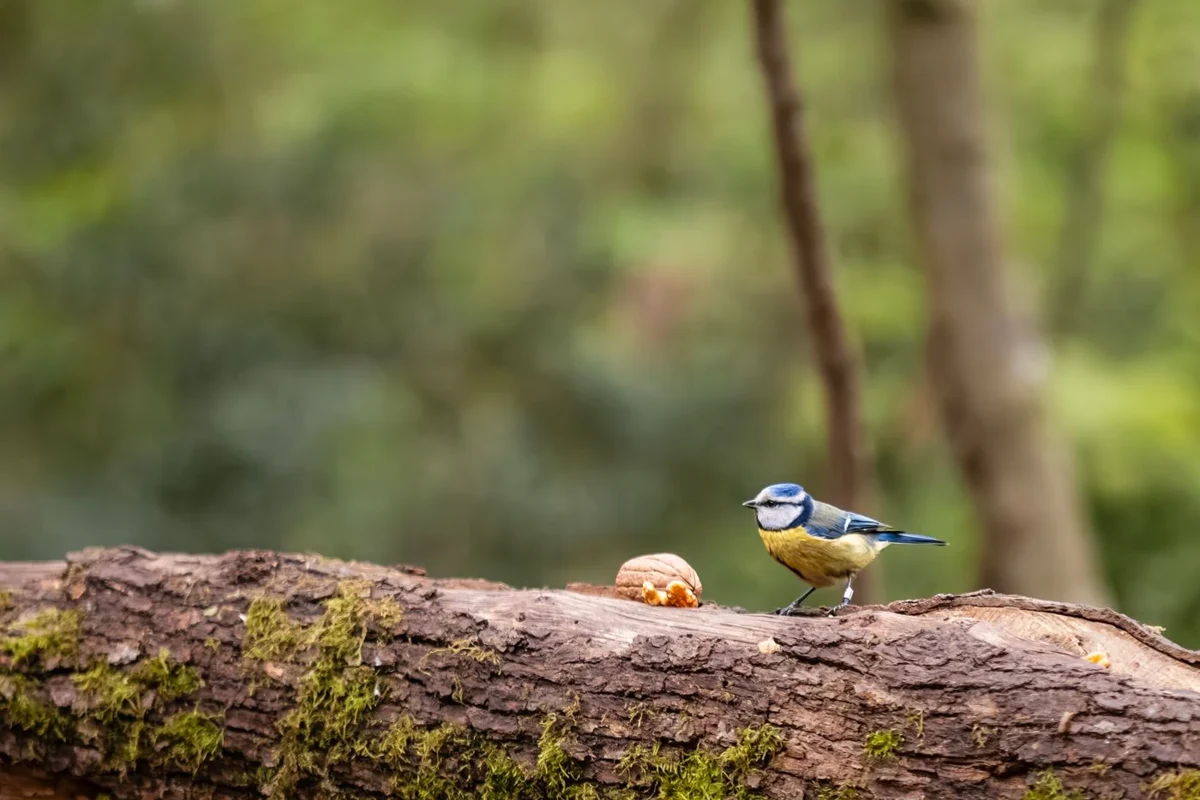
A blue tit is rarely a still arrangement of blue, yellow and white. It reaches, hangs, turns and disappears behind leaves. Learning that movement makes it easier to find the bird again when its colours are hidden. Start with a tree you can see comfortably from indoors and watch the ends of its smaller branches. Look for a brief change in the outline rather than searching for a blue head.
Once the bird pauses, check the pale face crossed by a dark eye stripe, blue crown and yellow underside. Young birds can look softer and less crisply marked, with yellowish faces. A pale cheek alone is not enough: great tits and coal tits also have contrasting heads. The blue cap is a much more helpful feature when the light allows you to see it.
Watch the branch, not just the bird
A useful exercise is to follow one bird for as long as it stays in view. Notice which parts of the tree it inspects. Does it work along a twig, reach into a cluster of leaves or return to the trunk? You need not identify every tiny item it picks up. A note saying that it searched beneath leaves is a more defensible record than deciding it caught a particular caterpillar you could not see.
Binoculars can make this unexpectedly difficult. Their narrow view turns a tree into an unrecognisable tangle. Lower them whenever you lose the bird, find its position with your unaided eyes, then raise the binoculars while keeping your head pointed in the same direction. Practising this on a familiar visitor is time well spent.
A visitor is not an individual identity
Several blue tits may pass through a garden within minutes, especially when travelling in mixed winter flocks. One bird leaving and another arriving does not tell you whether there are two individuals or one. For an informal count, record how many you actually see together and keep separate notes on repeated visits.
In spring, a bird carrying food may have a nest nearby. You can enjoy the behaviour from your existing position without following it to the entrance. Let it choose its route. If it waits with food instead of continuing, increase your distance and give it room to complete the journey.
A young bird in a mixed group
In early summer, try comparing the face of a young bird with that of an adult when both appear naturally in the same view. The youngster's yellowish cheeks can make the dark head markings look less crisp. Keep the comparison to those visible features rather than attempting an exact age in days. A bird seen alone later may be harder to place, but you will have a better reference than the single bright adult shown on many identification cards.
If there are several small birds in the tree, make sure the yellow face and blue crown belong to the same individual. In a fast-moving group, it is surprisingly easy to combine one bird's head with another bird's wing pattern in memory. Follow one bird for a few seconds, then begin a separate observation when you switch subjects. That simple discipline is useful far beyond blue tits.